Release v0.8.0
David Cruz · March 26, 2026
LuaRocks support
This is the big one. lpm can now install packages from the LuaRocks registry using the luarocks field in your lpm.json:
{
  "dependencies": {
    "luafilesystem": { "luarocks": "luafilesystem" },
    "busted": { "luarocks": "busted" }
  }
}
You can also add them from the CLI:
lpm add rocks:luafilesystemlpx and lpm install support it too:
lpx rocks:luacheck
lpm install rocks:busted
busted
If a package has a rockspec in a git repo, you can point to it manually with the rockspec field:
{
  "dependencies": {
    "middleclass": {
      "git": "https://github.com/kikito/middleclass",
      "rockspec": "./rockspecs/middleclass-4.1.1-0.rockspec"
    }
  }
}
LuaRocks support includes C module compilation — lpm will download LuaJIT headers and compile native modules automatically. Platform-specific modules are handled too.
This is an initial implementation. Things may not work perfectly across all packages — if you run into issues, please report them.
Archive dependencies
You can now install dependencies directly from a .zip or tarball URL:
{
  "dependencies": {
    "foo": { "archive": "https://example.com/foo.zip" }
  }
}
Flat lockfile for transitive dependencies
Previously, transitive dependencies weren’t always tracked reliably. Now lpm stores all dependencies - direct and transitive - flat in a single lockfile. This is how it was always intended to work, and it makes installs more deterministic and conflict-free.
Basic REPL
Running lpm repl drops you into an interactive Lua session with your project’s dependencies available:
lpm repl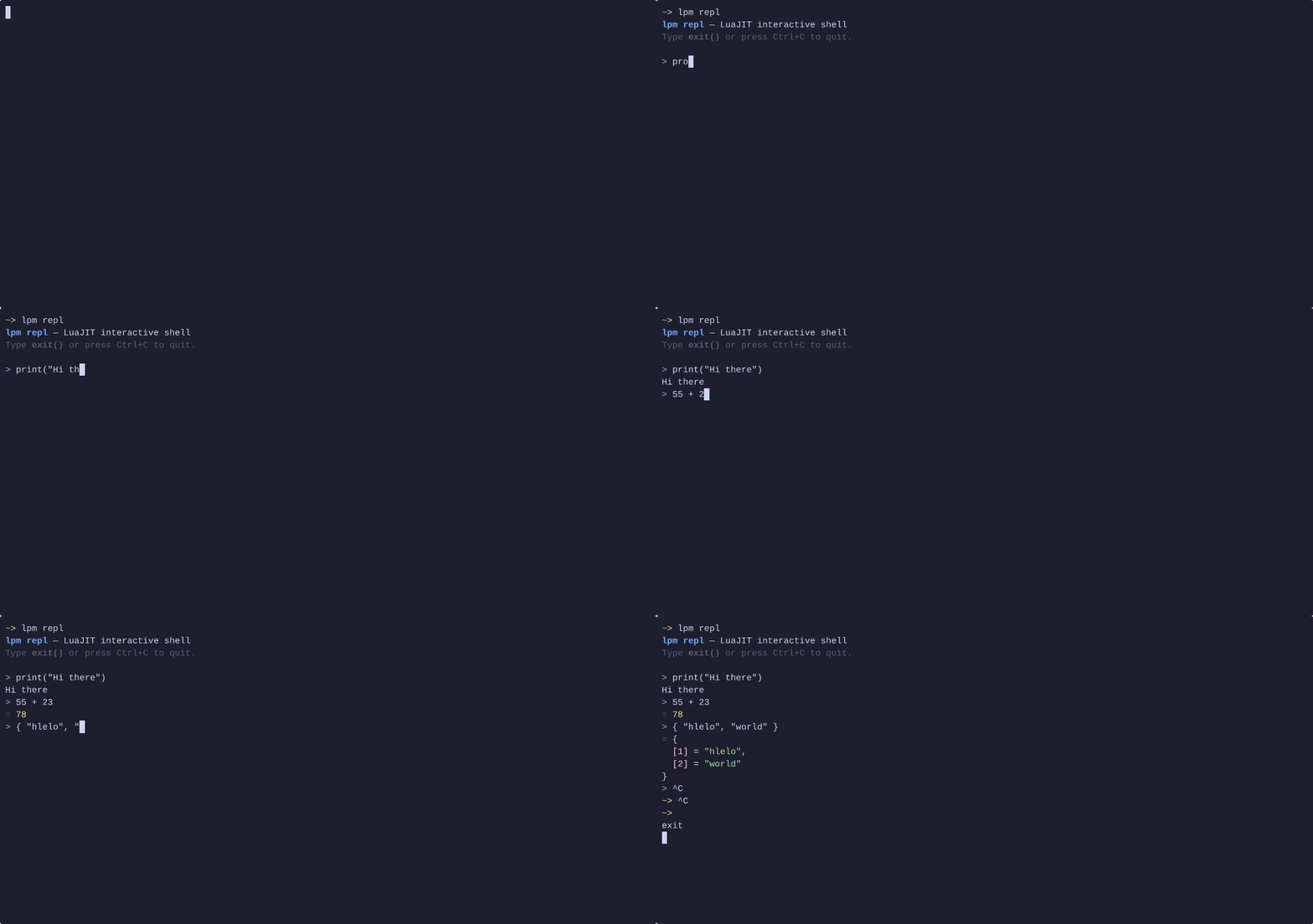
New lpm-test utilities
A few more additions to the test framework:
test.skip()           -- unconditionally skip a test
test.skipIf(cond)     -- skip if condition is true
test.deepEqual(a, b)  -- deep equality check
test.match(str, pat)  -- pattern match assertion
Skipped tests are now printed separately in the output.